
How Much Does Google Ads Cost for a Small Business?

Most business owners ask the same question before they run their first ad. How much do I need to spend to make Google Ads worth it?
I’ll save you the read and say a safe place to start is about $1,000 a month and scale up from there. But I have worked with smaller brands who keep it under $500 a month. The better question to ask is what you should expect in return for every dollar you spend. This guide I put together covers how Google Ads pricing works, what I would recommend spending, and some examples of success we’ve had with our clients.
How Google Ads Pricing Works
Google Ads runs on pay per click (PPC). You only pay when someone clicks your ad. You do not pay for the ad showing up. Pretty straightforward.
The price of each click comes from an auction. Every time someone searches, Google looks at how much each business is willing to pay per click and how relevant each ad is. The more competitive the search, the more each click costs. Don’t get me started on how much personal injury lawyers can expect to pay per click.
That means your cost per click depends on three things:
- Your industry. A legal or insurance click costs more than a click for a car wash.
- Your location. Austin and Round Rock are more competitive than smaller towns like Liberty Hill.
- Your ad quality. Google rewards relevant ads and landing pages with lower prices per click. (Meaning your ad can be great, but if your site sucks, your ad sucks.)
For real world context, a moving company we manage ads for averages a little over $7 per click.
Starting Out: Around $1,000 a Month
You do not need a huge budget to test Google Ads. Around $1,000 a month is enough for most local service businesses to get clicks, collect leads, and learn which keywords work. We focus on the searches most likely to turn into customers and the areas you serve.
Commit to at Least 3 Months
Google Ads has a learning curve. In the first few months, the account is collecting data on which keywords, ads, and locations bring in leads. We use that data to spend more efficiently and put more money behind what works, but this takes time.
One month is not enough to judge whether Google Ads works for your business. Sure, you will see some results, but we recommend committing to at least three months of ad spend to give it a serious shot. Pulling the plug after a few weeks usually means you paid for the learning and never got to use it. At least reduce your budget over time, and try to hit the three month mark.
Month 4 and Beyond
By month four, there is enough data to make smart budget decisions. You can see which campaigns bring in customers and what each lead costs. From there, you can adjust your budget based on the numbers instead of guessing.
Once the account proves it can turn spend into booked jobs, that’s when you scale. That might mean raising the budget on the campaigns that work or adding new services and service areas.
There is no ceiling here. We have clients who spend $25,000 a month on Google Ads. They got there by growing the budget step by step as the returns held up. We started out with a hundred keywords and twenty major cities, and have since refined it to a fraction of the keywords and locations.
Ad Spend vs. Management Fees
Your total cost has two parts. Ad spend goes straight to Google. The management fee goes to the team running your account. Your Google Ads management team should be checking campaigns almost daily, hence the fee.
At Dalton Does Ads, our management fee is a fixed amount based on your ad spend. It does not climb every time you raise your budget. There are no long-term contracts, and you always own your Google Ads account. The three-month recommendation is about giving your ads enough data. We typically ask for extensions a week before your budget will run dry, and can pause campaigns at any time.
What a Good Return Looks Like
Cost only matters next to what you get back. The number to watch is return on ad spend (ROAS). It shows how much revenue you earn for every dollar you spend on ads.
Case Study: Seattle Moving Company
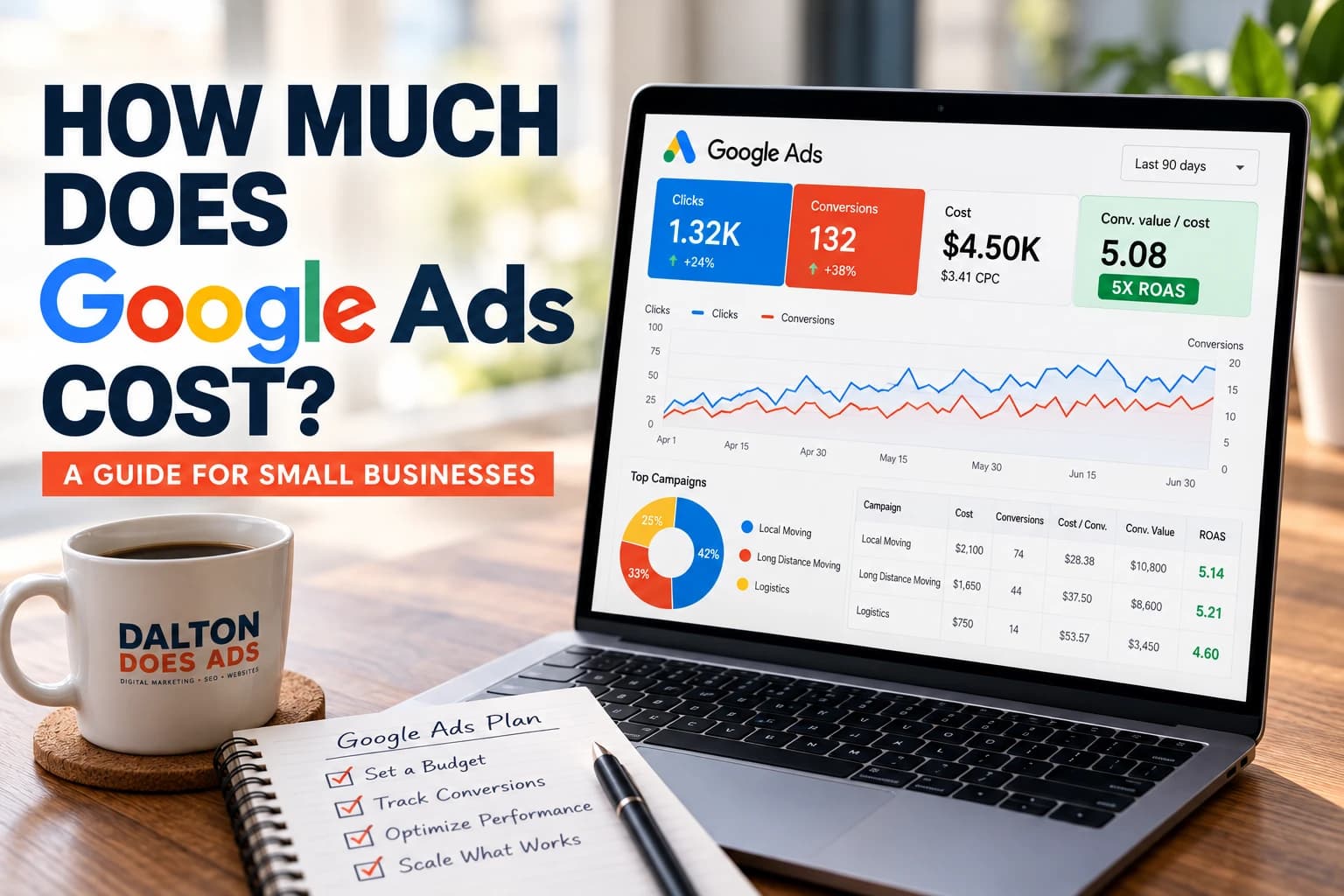
When we took over an ad account for a Seattle moving company, we rebuilt it from scratch into three Search campaigns. Those campaigns cover local moving, long distance moving, and logistics. Local moving was an established service, long distance was semi-established with less volume, and logistics was brand new.
Today the account runs on about $4,500 a month in ad spend. It returns roughly 5x that amount in booked jobs. Every $1 they put into Google Ads brings back about $5 in revenue.
~$4,500
Monthly ad spend
~5×
Return on ad spend in booked jobs
3
Search campaigns, each with its own budget
Here is what made the difference:
- Tight keyword control. We pause keywords that are spending without converting and move strong ones to phrase match.
- Conversion tracking we can trust. We tested every form and fixed a landing page that was not recording leads.
- Budget split by campaign. Each service gets its own budget so one campaign cannot drain the others.
- Tracking booked revenue. We measure booked jobs in the client’s CRM, not just form fills. That shows which campaigns make money. We created a custom portal to share with them so each day, they could attribute revenue to the success of the campaigns.
Ads Should Be Phase 3, Not Phase 1
We have turned down clients many times because they wanted to run ads before their website was ready. If your site is slow, confusing, or has no clear way to contact you, ads just send paying traffic to a page that loses it. You’d have better luck throwing dollar bills out of your branded truck.
We recommend building your online presence in three phases:
- Website. Start with a fast, modern website that is built to turn visitors into calls and form fills.
- SEO strategy and content. Next, build SEO and content so customers can find you on Google without paying for every click.
- Ads when you are ready to scale. Once your site converts and your foundation is in place, Google Ads adds fuel to something that already works.
Do not waste money on ads when you are not set up to succeed. A strong website makes every ad dollar go further.
Is Google Ads Worth It for a Small Business?
For most local service businesses, yes. Google Ads puts you in front of people who are searching for what you sell right now.
The businesses that do well start with a focused budget, track the right numbers, and scale only when the data supports it. The ones that struggle usually spend without tracking and never find out what is working.
Work With a Google Ads Agency in Austin
Dalton Does Ads is a Google Ads agency based in Liberty Hill. Our team manages PPC for businesses across Austin, Cedar Park, Round Rock, Georgetown, Leander, and the rest of Texas. Some of our clients are national brands. Whether you want to start with $1,000 a month or grow past $25,000, we will build a plan around your goals.
Talk to us about Google Ads management and find out where your ads stand.
Written by Dalton
I’ve started multiple businesses and run every part of them. That’s why I understand how local businesses operate. More about me →
More Google Ads articles
View allMore Google Ads tips are on the way. Check back soon for the next one.
More Google Ads tips are on the way. Check back soon for the next one.